Lontra Blade compressor (http://goo.gl/czsej) first uses: waste water aeration, oil free industrial air compressors and automotive superchargers.
PyroPure (http://goo.gl/VMBKN), Ethos Energy (http://goo.gl/5LPEF) also Mitie has published paper on potential (http://goo.gl/Ygm8w); for hazardous waste pay back can be only c. 2-3 years.
Oxford Photovoltaic's solar cell technology uses cheap, abundant, non-toxic & non-corrosive materials screen printed on glass. (http://goo.gl/kcJF4).
KiWiPower helps companies remove stress in National Grid by reducing electricity consumption when most polluting & expensive. National Grid pays for service as reduces peak demand (http://goo.gl/LDuUA)
Oxford PV and Lontra certainly looked quite unique; the former still working to finalise details; improve efficiencies (today 5% but aiming for 20%), scale up and guarantee a 25 year life span or something equivalent to the glazing facade in which they will be placed etc. Very exciting though the range of applications and colours etc..
http://www.sustainablebusiness.com/index.cfm/go/news.main

Wednesday, 25 May 2011


Thursday, 21 April 2011
China's 12th Five Year Plan: A Preliminary Look
Jonathon Porritt (forum for the future and Guardian) gave an excellent lecture and kick to do more, entitled City, Nations and Global Capital: Turning Sustainability into Reality, at the Institution of Civil Engineers (ICE) on 4 April.
Among other issues he did point out that this plan was worth reading and that it had a great deal of the right direction and leadership in it and as a better example of what needs to be planned and done than democratic countries are currently managing to show. So I thought I would read into it a little..
China's 12th Five Year Plan: A Preliminary Look
Among other issues he did point out that this plan was worth reading and that it had a great deal of the right direction and leadership in it and as a better example of what needs to be planned and done than democratic countries are currently managing to show. So I thought I would read into it a little..
China's 12th Five Year Plan: A Preliminary Look
 |
| From article in Opinion Maker Feb 25, 2001. http://goo.gl/HVKuj |
Wednesday, 20 April 2011
My accumulated Android apps
It's incredible how quickly these apps can accumulate.
I thought I would list them all before I forgot
My favourites (29 number)
 Backup to Gmail (0.4.3)
Better Keyboard 8 (Gingerbread Edition) (8.4.4), Better Keyboard Unlock Key (Unlock key 1.0)
BBC iPlayer (1.0)
Astrid Tasks (3.7.2), Astrid Locale (1.0), Astrid Power Pack (1.1.8)
CalenGoo (1.0.36)
Chrome to Phone (2.2.0)
ChromeMarks (2011.04.16)
Cycle Hire Widget (2.08)
Dolphin Browser HD (4.6.1), Dolphin License (2.0.0)
Folder Organizer (3.3.3)
gReader Pro (2.1.2)
Listen (1.1.4)
LogMeIn (1.2.171)
Locus Pro (1.5.2), Locus - addon AR (0.3), Locus - addon Contacts (1.1)
Ocado (1.3.4)
OpenTable (1.7.2)
Movies (3.3)
mSpot (1.3.2.88389b)
Rail Planner Live (1.7.1)
RealCalc (1.6.0)
RSA Vision (1.0b3)
RunKeeper (2.7.3.3)
Tasker (1.0.20u3)
TuneIn Radio (2.0)
TV-Guide (2.3.9)
TwonkyServer Mobile (1.1)
Urban Dictionary (3.5 - Improved widget + extended timouts for slow connections.)
Wattpad (2.0.2)
YouTube Remote (1.4)
Market now allows download from desktop to phone

Other good and installed (70 +, *** highly recommended)
I thought I would list them all before I forgot
My favourites (29 number)

Better Keyboard 8 (Gingerbread Edition) (8.4.4), Better Keyboard Unlock Key (Unlock key 1.0)
BBC iPlayer (1.0)
Astrid Tasks (3.7.2), Astrid Locale (1.0), Astrid Power Pack (1.1.8)
CalenGoo (1.0.36)
Chrome to Phone (2.2.0)
ChromeMarks (2011.04.16)
Cycle Hire Widget (2.08)
Dolphin Browser HD (4.6.1), Dolphin License (2.0.0)
Folder Organizer (3.3.3)
gReader Pro (2.1.2)
 |
| Folder Organizer screen displaying apps and folders |
LogMeIn (1.2.171)
Locus Pro (1.5.2), Locus - addon AR (0.3), Locus - addon Contacts (1.1)
Ocado (1.3.4)
OpenTable (1.7.2)
Movies (3.3)
mSpot (1.3.2.88389b)
Rail Planner Live (1.7.1)
RealCalc (1.6.0)
RSA Vision (1.0b3)
RunKeeper (2.7.3.3)
Tasker (1.0.20u3)
TuneIn Radio (2.0)
TV-Guide (2.3.9)
TwonkyServer Mobile (1.1)
Urban Dictionary (3.5 - Improved widget + extended timouts for slow connections.)
Wattpad (2.0.2)
YouTube Remote (1.4)
Market now allows download from desktop to phone
Other good and installed (70 +, *** highly recommended)
Friday, 1 April 2011
Experience and tools for setting up new UK private company
Well I can say it has been fun and there is so much help out there is appears to be quite straightforward (so far).
The Business Link support webpages have been and continue to be really helpful; so far I've used the governmental portal link, the comprehensive schedule of applicable regulations based on questions about business and created a timescales for VAT and company reporting etc.
Still looking for the more effective way doing accounts/invoice in the cloud without paying for large sums of money. I think it'll be excel spreadsheet for the time being - perhaps an accountant if I get any work!!
Also need to do a little work on the stationary and branding but it is early days yet.
The Business Link support webpages have been and continue to be really helpful; so far I've used the governmental portal link, the comprehensive schedule of applicable regulations based on questions about business and created a timescales for VAT and company reporting etc.
- Clear Books for me has been a huge success for affordable, simple to use online accounting software
- Companies House is all on-line as it HMRC - so all efficient there.
- Brighton Company Formations did the formation in hours and provided good supporting pack of information through the post
- Payroo looks right for me for online end-to-end PAYE management.
- Pipeline Deals has a simple but efficient log of contacts, opportunities and deals linked to Google contacts and calendars
 |
| Pipeline Deals - work status end March 2011 |
 |
| Pipeline Deals - work status mid-April 2011 |
Also need to do a little work on the stationary and branding but it is early days yet.
Saturday, 12 February 2011
Friday, 21 January 2011
I've discovered the YouTube leanback function - Sweet!
The system is great for reviewing YouTube subscriptions quickly - to be honest I couldn't be bothered with looking through the subscriptions at all before (a bit like Twitter in fact). I've used the free Android YouTube Remote app - which is very intuitive to use.
Subscriptions
The German subscription channel Deutsche Welle is particularly good and there is always something well produced and interesting (http://www.youtube.com/user/deutschewelleenglish).
The main Deutsche Welle website is also great and has free online language courses. I suppose the British Council does something similar but somehow it didn't seem as industrious as D-W!? The British Council's presence on YouTube seems to have more of a country focus for example http://www.youtube.com/user/britishcouncilhk and http://www.youtube.com/user/BritishCouncilUK
| Screen capture of leanback host machine controlled by phone - Panther's Dash - the go! Team |
The German subscription channel Deutsche Welle is particularly good and there is always something well produced and interesting (http://www.youtube.com/user/deutschewelleenglish).
The main Deutsche Welle website is also great and has free online language courses. I suppose the British Council does something similar but somehow it didn't seem as industrious as D-W!? The British Council's presence on YouTube seems to have more of a country focus for example http://www.youtube.com/user/britishcouncilhk and http://www.youtube.com/user/BritishCouncilUK
...I'd almost forgotten that feeling/sound - icradio // Android radio streaming
I also discovered that the Android TuneIn Radio app from RadioTime is excellent not only for streaming this radio but also various BBC live radio stations that my otherwise brilliant Dolphin Android browser won't let me listen to.
Tuesday, 18 January 2011
Saturday, 11 December 2010
The ICE toolkit for a developing world is online now and available for all to see
What exactly is the toolkit?
Bill Nighy, Actor and Oxfam Global Ambassador
The cards on sustainable infrastructure are particularly clear about the challenge we need to help address to ensure access to clean water, sanitation and hygiene.
The toolkit is an open-source set of materials and ideas to help engineers plan and deliver infrastructure for international development, poverty alleviation and the UN Millennium Development Goals (MDGs). It's a first in the civil engineering field and the work of ICE Past President Paul Jowitt and his Apprentices.
How can you access it?The full toolkit is now freely available to all engineers worldwide. For more information on the toolkit, please email apprentices@ice.org.uk
"Engineering is at the heart of most human endeavour, and to integrate it in this way to specifically address the problems of the developing world is admirable and to be encouraged. I salute this brilliant and original idea."
Bill Nighy, Actor and Oxfam Global Ambassador
The cards on sustainable infrastructure are particularly clear about the challenge we need to help address to ensure access to clean water, sanitation and hygiene.
 |
| Source: Morella, Foster and Banerjee 2008 |
Monday, 6 December 2010
Desertec Foundation going for fast global implementation of concept: clean power from deserts for climate protection and global energy security.
"Within 6 hours deserts receive more energy from the sun than humankind consumes within a year" Dr Gerhard Knies.
The DESERTEC Foundation was established on 20 January 2009 as a non-profit foundation with the aim of promoting the implementation of the global DESERTEC Concept "Clean Power from Deserts" all over the world.
The DESERTEC Foundation was established on 20 January 2009 as a non-profit foundation with the aim of promoting the implementation of the global DESERTEC Concept "Clean Power from Deserts" all over the world.
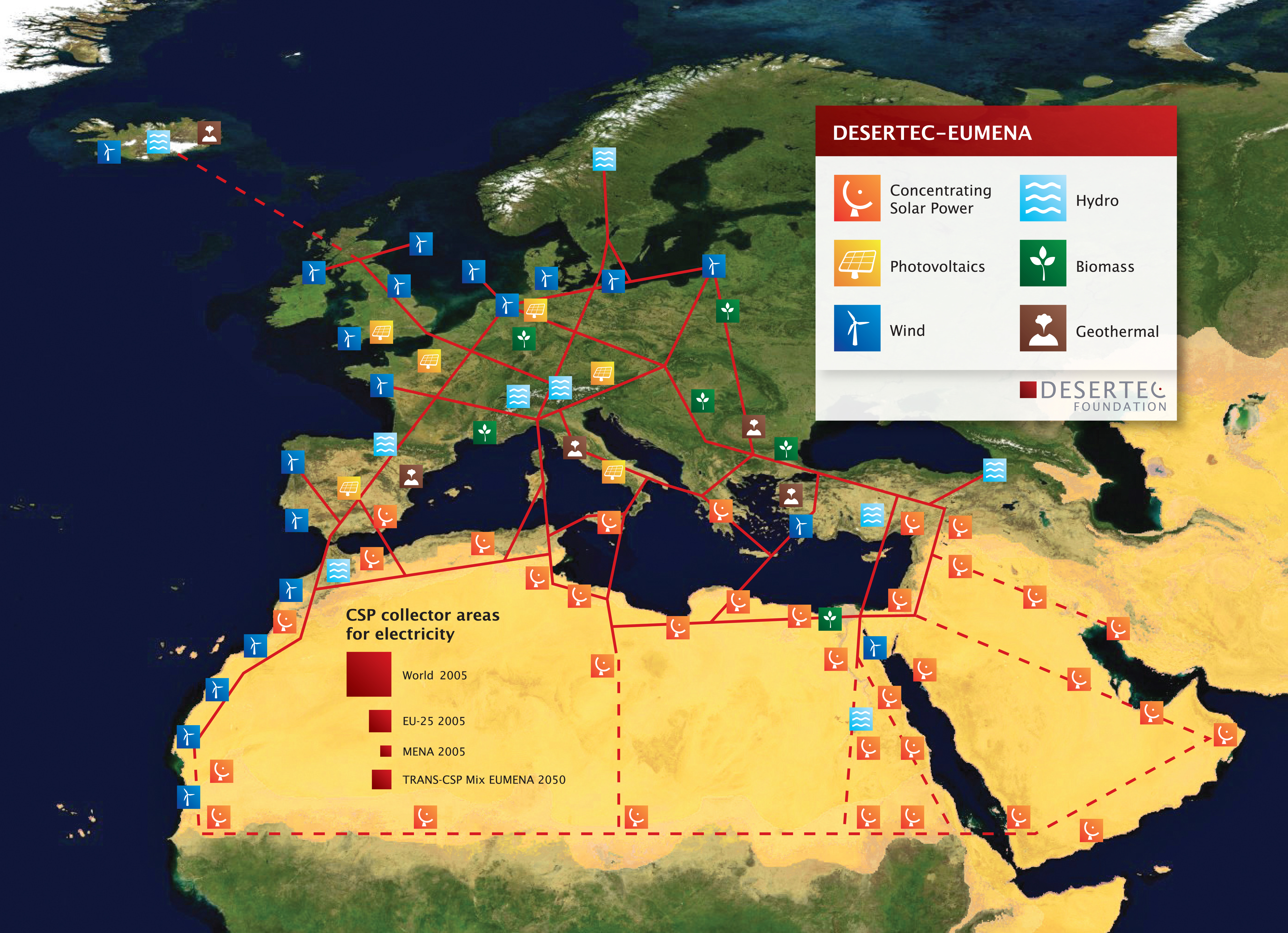 |
| Sketch of possible infrastructure for a sustainable supply of power to Europe, the Middle East and North Africa (EU-MENA) (Euro-Supergrid with a EU-MENA-Connection proposed by TREC). For illustration: the red squares indicate the space needed for solar collectors to produce the present power for the world (18.000 TWh/y, 300x300 km2), for Europe (EU 3.200 TWh/y, 125x125 km2) and for Germany or MENA (Middle East and North Africa, about 600 TWh/y, 55x55 km2). The square labelled "TRANS-CSP Mix EUMENA 2050" indicates the space needed for solar collectors to supply the needs for seawater desalination and about two-thirds of the electricity consumption in MENA in the year 2050 and about one-fifth of the European electricity consumption by Concentrating Solar Thermal Power Plants (2,940 TWh/y in total). 5 March 2009. Source: http://www.desertec.org/downloads/DESERTEC-Map_large.jpg . Author: TREC. This file is licensed under the Creative Commons Attribution-Share Alike 2.5 Genericlicense. |
Monday, 22 November 2010
Arup Bridge Stories Exhibition: Portrait of Bridge Designer (Angus Low)
Exhibition runs from 22 October 2010 - 21 January 2011 at Phase 2. Admission is free.
'Portrait of a Bridge Designer' by Piers Dennis. A short profile of Arup's Angus Low and his long and varied career designing bridges around the world.
Tuesday, 16 November 2010
Easy Boris - a useful tool for finding bike spaces in London without need for sophisticated smart phone apps!
my link is woodrush.com/bb but following the instructions anyone can create their own.
Saturday, 23 October 2010
Paul Morrell, Government Chief Construction Advisor - Major Strategic Priorities and Opportunities for Construction
Buildoffsite Stakeholder event (29 September 2010).
http://www.buildoffsite.com/pdf/Events/Stakeholder%20event%202010/Paul%20Morrell.pdf
http://www.buildoffsite.com/pdf/Events/Stakeholder%20event%202010/Richard%20Ogden,%20Buildoffsite.pdf
http://www.buildoffsite.com/pdf/Events/Stakeholder%20event%202010/Paul%20Morrell.pdf
http://www.buildoffsite.com/pdf/Events/Stakeholder%20event%202010/Richard%20Ogden,%20Buildoffsite.pdf
Offsite Production overview - Buildoffsite (industry wide campaign organisation prompting greater uptake of offsite technique in UK construction)
Richard Ogden, Buildoffsite Chairman and 'the man who built a McDonald's in two days', gave a seminar on 'how the construction industry can capitalise on offsite efficiencies' (October 19 BEST Residential Hub, NEC Birmingham).
Key question he suggested we ask : Why make a project out of a product?
Examples of some of the many advantages of offsite construction are:
- risk reduction; fewer people on site (manufacturing has significantly fewer accidents), controlled environment (quality control, wind and weather protection)
- lower costs in some areas; prelims, car parking
- speed of construction; GSK has reduced construction time for some mobile/temporary manufacturing units from 36 months to 3 months
- areas of buildings with complex services (e.g. science labs and washrooms in schools) have greatest advantages
He noted that there were three main types of offsite construction
- 2-D; panels
- 3-D; corridor modules for BAA reducing requirement to work airside
- Hybrid; houses
Other points picked up
- Retrofit in domestic housing is more difficult but there are opportunities that ought to be explored but require a change in perception; e.g. replace complete roofs built offsite
- Japan is world leader in offsite manufacturing - people aspire to live in highly engineered offsite manufactured housing units
- In the UK Laing O'Rourke (LOR) has invested heavily in their Design for Manufacture and Assembly' (DfMA) apporach and their Explore Industrial Park in Steetley. LOR claim this to be 'the most advanced facility of its type in Europe'. Others in the UK such as Carillion have said that the amount they do offsite is increasing every year.
- Offsite Powerpoint on Teachnet
 |
Download |
Offsite Production in the UK – prepared by HSE - June 2009
A Brief Overview
Report Prepared by Stephen Taylor: Construction Engineering Specialist Team: HSE
This paper discusses the historical and current application of modern methods of construction using off-site production techniques. The paper gives an overview of the various types of off-site construction; specific case studies illustrating current practice; and, the primary benefits to health and safety on construction sites through its implementation.
Keeping abreast of the winds of change | New Civil Engineer | DECC UK Electricity Generation Costs update (June 2010)
An interesting viewpoint from EC Harris published on 14 November, Keeping abreast of the winds of change | Features | New Civil Engineer, which provide an overview of how life cycle costs can be minimised whilst maintaining and sustaining assets' integrity.
EC Harris has also published an expert article entitled 'An Holistic view of value drivers will improve the return on investment for offshore wind farms'.
On Tuesday this week I attending a seminar by Dr Guy Doyle (Chief Economist, Energy and Carbon at Mott McDonald) who was presenting the findings contained within the Department for Energy and Climate Change (DECC)'s June 2010 update on the UK's Electricity Generation Costs. This was an interesting presentation on levelised costs, the lifetime discounted cost of an asset expressed in cost per unit energy produced, for a range of main technologies. This report is one that has been regularly updated and records and forecasts the levelised costs for projects started in 2009, 2013, 2017, 2023.
The forecasts take into consideration a range of factors such as a DECC view of the accelerating higher forward costs of carbon (central projection assumed to rise to £200/tonne in 2050 vs £30/tonne by others - today it is circa £12/tonne) and a Mott McDonald view on the technology progress and First of a Kind (FOAK) premiums.
EC Harris has also published an expert article entitled 'An Holistic view of value drivers will improve the return on investment for offshore wind farms'.
'The cost of delivering offshore wind projects is rapidly reaching £3.8 million per megawatt; at a time when investors are looking for costs of £2 million per megawatt to allow a viable return on investment. It will be a huge task to reduce costs by almost 50% when there is significant cost pressure due to market immaturity and supply chain inefficiencies.'
In this article they note, from their cross sector experience, that reducing costs is not the only way to improve the return on investment although it is still a very important one.
'The three main levers that can be pulled are the optimisation of generation, the impact of the prevailing tariff system and timely and efficient connection. All of these factors need to be addressed if the industry is to be successful in providing a viable return on investment.'DECC UK Electricity Generation Costs update
On Tuesday this week I attending a seminar by Dr Guy Doyle (Chief Economist, Energy and Carbon at Mott McDonald) who was presenting the findings contained within the Department for Energy and Climate Change (DECC)'s June 2010 update on the UK's Electricity Generation Costs. This was an interesting presentation on levelised costs, the lifetime discounted cost of an asset expressed in cost per unit energy produced, for a range of main technologies. This report is one that has been regularly updated and records and forecasts the levelised costs for projects started in 2009, 2013, 2017, 2023.
The forecasts take into consideration a range of factors such as a DECC view of the accelerating higher forward costs of carbon (central projection assumed to rise to £200/tonne in 2050 vs £30/tonne by others - today it is circa £12/tonne) and a Mott McDonald view on the technology progress and First of a Kind (FOAK) premiums.
'For most mature technologies the main drivers of costs are market conditions and commodity prices, with some discounting for installations with multiple units. For these technologies, the main scope for technical progress is in the application of best practice construction management. Even though the UK has yet to build an advanced supercritical coal plant, there is likely to be comparatively little difference (less than 10%) between the first of a kind (FOAK) and the nth of a kind (NOAK) plant. CCGT (Combined Cycle Gas Turbine) technology is already at the NOAK level, as is onshore wind. Offshore wind still has some significant learning, especially in the area on cost effective foundations/anchoring and in reducing maintenance and servicing costs. Moving to deeper water and further offshore means wind faces a moving target as this tends to require new untried technical solutions.
Third generation nuclear plants and especially CCS are at an earlier stage, although for the former there are probably easier wins to be had in terms of improved project management than in technology changes.'The resultant projections are interesting when taken in the context of the two EC Harris articles, the anticipated investment in Crown Estate and Scottish wind programmes and the Energy Technology Institute's 2010 Marine Energy Technology Road Map. I have included 2009, 2013 and 2023 start dates in order to note the trends the report identifies.
.jpg) |
| DECC report: Levelised costs of main technologies for projects started in 2009 - mix of FOAK and NOAK (£/MWh) |
Round 3 Wind FOAK (c. £180/MWh) is not only over twice cost of Gas CCGT (c. £80/MWh) started in 2009 but is also significantly higher than the average cost of energy in generation today at £45/MWh! Even with 2 no ROC (Renewable Obligation Certificates) it must struggle to be viable as FOAK technology and will need a real focus on cost reduction, optimisation of generation, the impact of the prevailing tariff system and timely and efficient connection (see EC Harris notes above). |
Thursday, 21 October 2010
TfL - Interchange Best Practice Guidelines
A seminar at The Infrastructure Show, NEC 19 October 2010, considered how value for money can be achieved in interchange upgrades over the long term. John McNulty - Head of Interchange, also described methods in use in London by Transport for London (TfL) to ensure costs are kept low where possible, knowledge shared and the whole range of options considered to maximise the opportunity to ensure public transport, walking and cycling are as attractive as they can be.
Best Practice guidelines have been published and updated as knowledge and case studies have been recorded. These are based around four design themes Efficiency, Usability, Understanding and Quality.
Interchanges have been defined and graded into a number of types from strategic, inter-regional to local. TfL have classified a total 645 material interchanges, where people can change between one mode of transport to another. The Legible London totem signs are an example of the effort to made to provide simple information to people in a consistent way; at the same time it provides a great opportunity to 'de-cluster' streets of vast numbers of signage etc. and integrate relevant information in one place.
This itself is not a simple job as there are many views that could have been considered; this article in the Londonist attests.
The use of a common relevant transport model across all the different stakeholders, for recent major and complex interchanges such as King's Cross/St Pancras, have provided an invaluable tool to ensure demand and design requirements are fully understood, considered and implemented.
The use of a common relevant transport model across all the different stakeholders, for recent major and complex interchanges such as King's Cross/St Pancras, have provided an invaluable tool to ensure demand and design requirements are fully understood, considered and implemented.
It would be useful to see some simple key metrics for the potential capacity (local and regional), intended design/ functionality, and actual use of the interchanges in each category types. This would enable people to see the tangible benefits of better and optimal interchange design, the value of investing in the detail of the scheme for long-term gains in performance and behavioural change.
+sample+EXTRACT.pdf) |
| Example of two pages within the TfL Quick Reference Guide |
Friday, 15 October 2010
TfL Cycle Hire Scheme (Boris Bikes) and Other Scheme Visualisations - Oliver G O'Brien
Suprageography - http://oliverobrien.co.uk/
Weather at UCL http://www.casa.ucl.ac.uk/weather/
London Profiler (on Google Map interface) http://www.londonprofiler.org/
Oliver O'Brien is a research associate with CASA (Centre for Advanced Spatial Analysis), University College London.
1-19 Torrington Place - London - WC1E 7HB.
Weather at UCL http://www.casa.ucl.ac.uk/weather/
London Profiler (on Google Map interface) http://www.londonprofiler.org/
Oliver O'Brien is a research associate with CASA (Centre for Advanced Spatial Analysis), University College London.
1-19 Torrington Place - London - WC1E 7HB.
Tuesday, 12 October 2010
Monday, 11 October 2010
Think, Play, Do Group Limited - Case Study..
'In a world where disruptive technologies and new business models can change the entire game and new competitors emerge from across the globe, the challenge facing organisations is to intensify their capacity for innovation... and capture the rewards rather than cede them to competition. The Think, Play, Do Group was set up in 2005 to provide commercial access to expertise of the Innovation Studies Centres at Imperial College London and the University of Queensland, Brisbane.'
Video - Professor David Gann, Head of Innovation and Entrepreneurship Group Imperial College Business School, on the Laing O'Rourke Case Study
Video - Professor David Gann, Head of Innovation and Entrepreneurship Group Imperial College Business School, on the Laing O'Rourke Case Study
Monday, 13 September 2010
Low Carbon UK : Go for engineering challenge
Fundraiser: Hugh PorterMy page: http://uk.virginmoneygiving.com/HughPorter
My plan is to cycle from Orkney to Kent raising money for two charities
- The Outward Bound Trust which is dedicated to unlocking potential in young disadvantaged people and
- Help for Heroes - this is about me doing my little bit to show support for these extraordinarily brave and mainly young people.
I intend to look at selected engineering feats (mainly civil engineering) along the route and consider the implications of the big changes I (and perhaps we all) need to make to move to a low carbon economy. I will take David JC MacKay's book Sustainable Energy - without the hot air with me as a reference guide.

Through Virgin Money Giving, you can sponsor me and donations will be quickly processed and passed to charities. Virgin Money Giving is a not for profit organisation and will claim gift aid on a charity's behalf where the donor is eligible for this. I really appreciate all your support and thank you for any donations.

Monday, 9 August 2010
Thursday, 29 July 2010
Innovation Studies Centre - note and links
'The Innovation Studies Centre (ISC), conducts research on the innovation process from knowledge creation to commercialisation.' It aims to influence policy and practice by working at the inter-face of science, engineering and business management..
'Innovation has never been more important as organisations face fierce global competition, rapidly developing technologies and diminishing world resources.
'Innovation has never been more important as organisations face fierce global competition, rapidly developing technologies and diminishing world resources.
Led by Professor David Gann, the ISC was established in 2003 at Imperial College London and funded by the EPSRC (Engineering and Physical Sciences Research Council), to develop, test and launch new research projects and programmes.'
Wednesday, 21 July 2010
BERR UK Energy flow charts - a useful resource
The Energy flow chart 2008[filetype:pdf filesize: 376.24Kb] illustrates the flow of primary fuels from home production and imports to their eventual final uses. DECC shows them in their original state, and after being converted into different kinds of energy by the secondary fuel producers. The flows are measured in million-tonnes of oil equivalent (mtoe), with the widths of the bands approximately proportional to the size of the flow they represent.
The next update, in summer 2010, will contain the 2009 UK energy flows.
According to Wikipedia 1 MWh = 0.086 toe, therefore 1 TWh = 0.086 mtoe.
So an annual year output of say a Cardiff-Weston Tidal Barrage at 17 TWh would be equivalent to 1.5 mtoe. This is above the same as the consumption of the UK's Iron and Steel industry but perhaps not all generated at the right time!

NB Best place to view chart is PDF on BERR website above but it is shown below to show concept.

NB Best place to view chart is PDF on BERR website above but it is shown below to show concept.
Wednesday, 14 July 2010
Runkeeper - the place to log sports
I'm impressed with this site, even if I don't own an iPhone or any other Apple gadgets.
1) It allows you to add in all types of activities

2) then you log details
3) and you can compare to previous matched or similar activities
.jpg)
1) It allows you to add in all types of activities

2) then you log details
3) and you can compare to previous matched or similar activities
.jpg)
Kerb Games has many viral games - including one for Construction Industry Training Board (CITB)
The Construction Industry Training Board game is at this link CITB Blocsmart viral (puzzle) game. It felt quite difficult to me but then I am not very experienced in playing games.
 |
| ConstructionSkills |
NB all the links in this post will result in a Kerb Games sounds being heard!
RAF Global Rescue (Royal Air Force - Be Part of It)
Bat Out of Hell
Killawatt
NB Clicking on Read More >> below will bring up an embedded flash game, Move on Up, and play 2 seconds of Kerb Games sound. The sound can then be toggled on and off from the flash picture.
Monday, 12 July 2010


Sunday, 4 July 2010

Tuesday, 29 June 2010
Route visualisation with cycle routes
Link to free cycle maps at opencyclemaps.org >> National and international cycle maps
Local runs and cycle routes
Local runs and cycle routes
Sunday, 20 June 2010


Subscribe to:
Posts (Atom)