1. Purpose
Strategy
to lead
1. the strategic planning and development of Any Company
o through the ongoing internal change programme and
o development of clear strategies for organic and non-organic growth,
- targeting growth towards £1bn plus by 2010, enhanced margins to an average PBT greater than 3%, and
- having a clear long term 5-10 year plan to reflect changing market conditions
2. the regular strategic review of the business and its markets including lead in
o assessment of acquisitions subsequently playing key roles in
i. due diligence
ii. final agreement
iii. integration activities
to create and generate
3. innovative customer solutions and generate sustainable, margin enhancing new market opportunities from current core capabilities
Cultural Change Programme
to support and assist
1. MDs to shift client relationships towards long term, mutually dependant, high-value business relationships
o through enhanced business development,
i. partner selection,
ii. market selection,
o process improvement and
o high impact operational support and coaching
2. the MD and HRD in raising the calibre of business leadership across the organisation including talent development
3. the MD in the ongoing implementation of process improvement and cultural change in Any Company, involving all
o functions and
o business units.
Process delivery
to create
o brand positioning, marketing,
o internal and external communications,
o business development and business improvement functions
o to create sustained growth, market leading positions in our chosen sectors and
o enhanced business reputation
______________________________________________________________
2. Responsibilities:
1. Strategic planning
o acquisition planning and implementation
2. Business development
o Customer solutions
o Marketing and brand
3. Internal and external communications
4. Business improvement
______________________________________________________________
3. Initial Objectives:
Strategic planning
Assess and critique the 2007 strategy submission and develop action plan,
o including assessment of potential new markets and actions to progress
· Monitor and manage our progress against our strategic projects.
· Support or lead the roll-out of our vision and strategy.
· Take ownership of the corporate scorecard.
· Lead the initial scoping and for cross group working in
o regeneration,
o property development and
o complex projects in common sectors (eg Rail, Nuclear)
Business development
· Recruit and/or develop high calibre BDM’s
o agree roles, targets and objectives and confirm meeting and reporting structure
· Support the MD’s in business development strategies for
o relatively new sectors (e.g. power generation, defence, airports, ports, Crossrail) and
o ongoing areas of targeted growth or market share defence (e.g. Rail, Renewables and Water)
· Assess existing customer relationships and identify continuous improvement opportunities
· Review current JV partners and any actions required to address future needs
· Embed and champion account management approach across BU’s
o assess BDM processes and agree a cross company business development plan
Internal and external communications
· Recruit or grow a high performing communications team who are
o proactive and
o recognised by the business units and sites as adding real value to their operational activities
· Develop an innovative and high impact PR and marketing plan
o Develop a detailed plan to raise the Any Company brand awareness,
§ utilising feedback and workshops held to date and facilitate company-wide engagement
o build upon existing plans to enhance external communications; e.g. web site, external literature, site branding etc
o Oversee the completion of a comprehensive library of
§ case studies,
§ pre-qualification materials and
§ other specific marketing literature, both operational and cultural
· Continue to support Cascade, roadshows and other internal communications events which have proved successful
Business improvement
· Lead the cost reduction programme.
o Set targets for efficiency savings and deliver in conjunction with EMT directors
· Chair business improvement forum
· Develop a business improvement plan for Any Company
o including assessment of specific new processes, in conjunction with process owners.
o Support the MD and *** in developing a best practice framework and implement processes and coaching to embed this into our culture
o Assess opportunities for specific performance improvement activities
· on live contracts with resulting client engagement
· Actively support the Values roll-out programme
· Work with *** to develop a company performance model and fully implement
o KPI’s and
o other performance and data requirements
· Assess our CSR strategy and
o support/coach current team to take a step change in our current culture, strategy and profile

Sunday, 27 January 2008
A Strategy Director role


Friday, 18 January 2008
TradeStone's RADICAL vision!
R – Rapid Response
A – Agility (Opportunity/Challenge Response)
D - Dramatic Design
I – Innovation
C – Controls (QA/QC/Regulatory)
A – Alternative (Channels/Sourcing)
L – Leapfrog (the Competition)
TradeStone’s radical results include: 200 to 400 basis points to the bottom line; sales increases of 35 percent; average consumer spend increases of seven percent; and sell through at margins of 78 percent.TradeStone…Private Label Solutions; Radical Results!
Thought Leadership
 According to commentators such as Elise Bauer, a distinguishing characteristic of a thought leader is "the recognition from the outside world that the company deeply understands its business, the needs of its customers, and the broader marketplace in which it operates."[2]
Leadership is deliberately causing people-driven actions in a planned way to accomplish the leaders agenda. Phil Cosby[3]
http://www.som.cranfield.ac.uk/som/cbp
Wednesday, 16 January 2008
Ansoff's Matrix
 A basic overview is available on Wikipedia at http://encyclopedia.thefreedictionary.com/Product-Market+Growth+Matrix. Basic thing to remember is that it is always good to have a balance in a business and personal portfolio – suggested split as per percentage below.
Thursday, 10 January 2008
UK Ports

see http://maps.google.com/maps/ms?hl=en&ie=UTF8&om=0&msa=0&msid=102119844401171836975.0004436095e195ea75f5e&t=h&ll=52.059246,1.230469&spn=3.34373,9.558105&z=7
Felixstowe (GBFXT)
Fishguard (GBFIS)
Fleetwood (GBFLE)
Goole (GBGOO)
Grangemouth (GBGRG)
Holyhead (GBHLY)
Immingham (GBIMM)
Isle of Grain (GBIOG)
Portbury (GBPRU)
Sheerness (GBSHS)
Southampton (GBSOU)
Stranraer (GBSTR)
Teesport (GBTEE)
Thamesport (GBTHP)
Tilbury (GBTIL)
Warrenpoint (GBWPT)
Monday, 31 December 2007
Brilliant Quotes Of Management
Recently, a magazine ran a contest. They were looking for people to submit quotes from their real-life managers. Here are some of the submissions:
1. As of tomorrow, employees will only be able to access the building using individual security cards. Pictures will be taken next Wednesday and employees will receive their cards in two weeks. (This was the winning quote from Fred Dales at Microsoft Corp in Redmond, WA.)
2. What I need is a list of specific unknown problems we will encounter. (Lykes Lines Shipping)
3. E-mail is not to be used to pass on information or data. It should be used only for company business (Accounting manager, Electric Boat Company)
4. This project is so important, we can't let things that are more important interfere with it. (Advertising/Marketing manager, United Parcel Service)
5. Doing it right is no excuse for not meeting the schedule. No one will believe you solved this problem in one day! We've been working on it for months. Now, go act busy for a few weeks and I'll let you know when it's time to tell them. (R&D supervisor,
Minnesota Mining and Manufacturing/3M Corp.)
6. My Boss spent the entire weekend retyping a 25-page proposal that only needed corrections. She claims the disk I gave her was damaged and she couldn't edit it. The disk I gave her was write-protected. (CIO of Dell Computers)
7. Quote from the Boss: "Teamwork is a lot of people doing what I say." (Marketing executive, Citrix Corporation)
8. "How About Friday?" My sister passed away and her funeral was scheduled for Monday. When I told my Boss, he said she died so that I would have to miss work on the busiest day of the year. He then asked if we could change her burial to Friday. He said, "That would be better for me." (Shipping executive, FTD Florists)
9. "We know that communication is a problem, but the company is not going to discuss it with the employees." (Switching supervisor, AT&T Long Lines Division)
10. We recently received a memo from senior management saying:
"This is to inform you that a memo will be issued today regarding the subject mentioned above." (Microsoft, Legal Affairs Division)
11. One day my Boss asked me to submit a status report to him concerning a project I was working on. I asked him if tomorrow would be soon enough. He said "If I wanted it tomorrow, I would have waited until tomorrow to ask for it!" (New business manager, Hallmark Greeting Cards.) (Note: He must be related to my boss!
12. Speaking the Same Language: As director of communications, I was asked to prepare a memo reviewing our company's training programs and materials. In the body of the memo one of the sentences mentioned the "pedagogical approach" used by one of the training manuals.
The day after I routed the memo to the executive committee, I was called into the HR director's office, and told that the executive vice president wanted me out of the building by lunch. When I asked why, I was told that she wouldn't stand for "perverts" (pedophilia?) working in her company.
Finally he showed me her copy of the memo, with her demand that I be fired - and the word "pedagogical" circled in red. The HR manager was fairly reasonable, and once he looked the word up in his dictionary, and made a copy of the definition to send back to her, he told me not to worry. He would take care of it.
Two days later a memo to the entire staff came out directing us that no words which could not be found in the local Sunday newspaper could be used in company memos. A month later, I resigned. In accordance with company policy, I created my resignation memo by pasting words together from the Sunday paper. (Taco Bell Corporation) roflmao
13. This gem is the closing paragraph of a nationally-circulated memo from a large communications company:"(Company name) is endeavorily determined to promote constant attention on current procedures of transacting business focusing emphasis on
innovative ways to better, if not supersede, the expectations of quality!" (Lucent Technologies)
Monday, 24 September 2007
Change
Change agents need more than raw analytical power to solve complex business problems; interpersonal skills are also critical if they are to lead others through change. Important traits for a potential change agent include empathy, strong communication skills, perseverance in the face of challenge or ambiguity, and an ability to deal with conflict constructively.
Change agent teams must also make a strong effort to hire people with an appropriate mix of skills. A balance should be struck between young “academic types” who have strong analytical capabilities and seasoned managers who have proven track records within the organisation. Working together, these two types of employees complement each other, broadening the team’s skill base and providing for the two-way transfer of knowledge and capabilities within the team.
Smile and the whole world smiles with you.

 A smile costs nothing but gives much.
It enriches those who receive without making poorer those who give.
It takes but a moment but the memory of it sometimes lasts forever.
None is so rich or mighty that he can get away without it, and none is so poor but he can be made rich by it.
A smile creates happiness in the home, fosters goodwill in business and is the countersign of friendship.
It brings rest to the weary, cheer to the discouraged, sunshine to the sad, and is nature's best antidote for trouble.
Yet it cannot be bought, begged, borrowed, or stolen, for it is something that is of no value to anyone until it is given away.
Some people are too tired to give you a smile.
Give them yours, as none needs a smile so much as he who has no more to give.
Tuesday, 31 July 2007
European Strategies for LCCS
- Which locations are most important for sourcing today and five years time?
- Which supplies are suitable for sourcing in low-cost countries?
- What risks are associated with low-cost country sourcing?
- What measures have companies taken to facilitate low-cost country sourcing?
- What is the impact on corporate performance from low-cost country sourcing?
Moreover, the findings suggest that low-cost country sourcing activities must be carefully planned, executed and evaluated in order to cope with risks and other types of costs that may offset benefits if not done properly. Some of the key findings are:
- Companies are still sourcing extensively in the home country, followed by neighbouring countries. Thus, nearshoring is highly prevalent today and the situation will persist to a large extent until at least 2010. 48 percent of the respondents rank their home country among the three most important sourcing countries.
- Over the next five years, the value of goods and services sourced in low-cost countries will increase by 64 and 60 percent, respectively. In other words, low-cost country sourcing will increase dramatically by 2010.
-
- 48 percent of the respondents align LCCS strategy to the corporate strategy to a high or very high extent. 61 percent of the respondents claim to involve senior management in formulation of visions for LCCS to a high or very high extent.
- Quality and total landed cost savings are the two most widely implemented performance metrics. These are implemented to a high or very high extent among 56 and 45 percent of the respondents, respectively.
- 70 percent of the respondents have experienced positive impact on total costs, 61 percent have experienced positive impact on transportation costs and 50 percent have experienced positive impact on labour costs.
Wednesday, 25 July 2007
How a simple Letter of Credit Works
- XCo goes to HSBC and requests a $500,000 letter of credit, with Beijing Computers as the beneficiary.
- HSBC can issue an LC by XCo funding it directly with a deposit of $500,000 plus fees (minimum 1%+ can run as high as 8%).
- HSBC sends a copy of the LC to the Shanghai Business Bank, which notifies the Beijing Computers that payment is ready and they can ship the merchandise we have ordered with the full assurance of payment to them.
- On presentation of the stipulated documents in the letter of credit and compliance with the terms and conditions of the letter of credit, HSBC transfers the $500,000 to the Shanghai Business Bank, which then credits the account to the Beijing Computers by that amount.
Many exporters have misunderstood that the payment is guaranteed after receiving the LC. The issuing bank is obligated to pay under the letter of credit only when the stipulated documents are presented and the terms and conditions of the letter of credit have been met accordingly
1. After a contract is concluded between a buyer and seller, the buyer's bank supplies a letter of credit to seller.
2. Seller consigns the goods to a carrier in exchange for a bill of lading.
3. Seller provides bill of lading to bank in exchange for payment. Seller's bank exchanges bill of lading for payment from buyer's bank. Buyer's bank exchanges bill of lading for payment from buyer.
4. Buyer provides bill of lading to carrier and takes delivery of goods.
NB: Typically, the documents a beneficiary has to present in order to avail himself of the credit, are commercial invoice, bill of lading, insurance documents. However, the list and form of documents is open to imagination and negotiation and might contain requirements to present documents issued by a neutral third party evidencing the quality of the goods shipped.


Strategies for Working Together When Positioned a World Apart
Around the world, a wide range of corporate tasks are being performed by teams of employees who rarely if ever meet in person.
The rise of so-called virtual teams is hardly surprising, given the vast investments corporations are making in internal communications and networks. Technically, it's no longer a challenge to work closely with colleagues in distant locations or to hold meetings with participants scattered around the globe.
In practical terms, however, plenty of hurdles remain. Among them: time-zone differences that make quick exchanges difficult and cultural miscues that can cause misunderstandings. Teams that don't meet in person are considered less likely to develop the kind of chemistry seen in teams that do -- an element that's often seen as a key factor in making teams productive.
|
Video: WSJ's Carol Hymowitz interviews Lynda Gratton, professor of management at the Discuss: Have you or your company set up a virtual team? |

A recent study of virtual teams at multinational companies -- teams ranging in size from four to nearly 200 -- found that many of the groups were beleaguered by just these kinds of long-distance challenges, to the point of being in continuous danger of breaking up. Other virtual teams, meanwhile, were high performers, virtual hot spots of innovation and energy.
Why does one virtual team thrive while another stumbles? What differentiates the two?
It's an important issue, as companies become more reluctant to bear the expense of frequent in-person meetings -- and employees increasingly resent the burdens travel places on their health and personal lives. Finding a way to make virtual teams work better is therefore crucial if companies are going to get the most productivity out of their far-flung work force.
This research began with in-depth case studies of successful virtual teams at a number of companies, including BP PLC, Nokia Corp. and Ogilvy & Mather, a unit of WPP Group PLC. In addition, a research team at
Based on our findings, we have identified certain traits and practices common to the most successful virtual teams and their employers. Here, then, are 10 golden rules for making virtual teams more productive:
1. Invest in an online resource where members can learn quickly about one another.
Because of their physical separation, one of the biggest challenges virtual-team members face is an inability to easily learn about one another and what each person brings to the project. Online tools can help, in the same way that social-networking Web sites help college and high-school students get to know other members of their communities. Our research showed that such practices are often unfamiliar to those who graduated from college years ago, but they can be enormously powerful when used in virtual teams.
Take the advertising company Ogilvy & Mather. Its late founder, David Ogilvy, placed enormous emphasis on sharing knowledge within the company. More than a decade ago he invested in an internal IT-based community he called Truffles. As a gourmet, Mr. Ogilvy appreciated the rich taste of a truffle, and he believed that people should search for knowledge with as much energy and enthusiasm as a pig searches for truffles in the oak forests of
Truffles gives access to shared projects and a database of company knowledge. It provides forums for the many hundreds of communities of interest that have sprung up in the firm, where ideas and insights are shared. Truffles also features a detailed and frequently updated directory of all Ogilvy employees, giving each an opportunity to list the aspects of work that he or she is passionate about.
Such capabilities help ensure that even virtual-team members can rapidly get to know something about one another. For instance, when a big Ogilvy client wants to launch an ad campaign simultaneously in all of its global markets, a virtual team can start working together effectively within days.
2. Choose a few team members who already know each other.
Virtual teams are much more likely to be productive and innovative if they include some people who already know each other. So-called heritage relationships are crucial to rapidly building networks among the team members.
A word of warning, though: If a majority of the people on a team already know each other, the team can become stale and predictable. It's often through the unexpected insights of new colleagues that innovation is sparked.
3. Identify "boundary spanners" and ensure that they make up at least 15% of the team.
Boundary spanners are people who, as a result of their personality, skills or work history, have lots of connections to useful people outside the team. BP has a long history of colleagues from different business units working together to span the corporate boundaries that separate them.
Another word of warning, though: Having too many boundary spanners risks giving the team so many connections to the outside that it loses its sense of identity and its shared goal.
4. Cultivate boundary spanners as a regular part of companywide practices and processes.
The networking role that boundary spanners play -- not just on virtual teams but in the company at large -- is so important that companies should try to keep them in continuous supply.
At Nokia, for example, a huge range of routines and processes support and encourage employees to expand their personal networks. To start with, new hires are formally introduced to at least 10 people both within and outside of their departments. It's an effort that extends outside the company as well. Nokia has strong working relationships with the faculties of more than 100 universities, co-hosting conferences, sharing research initiatives and supporting postgraduate work.
Growing boundary spanners throughout the company helps ensure that when virtual teams are pulled together, at least some of the members likely will have met before.
5. Break the team's work up into modules so that progress in one location is not overly dependent on progress in another.
Coordinating work across distant time zones can be a continuing battle. Many teams we studied sank into acrimony as one part of the team waited for another to complete part of a task, or as one group worked faster than another.
Whenever possible, assign tasks to team members in different locations that allow them to move ahead at their own pace. Depending on the type of work, try designing the work flow so that contributions from different locations can be assembled into a whole toward the end of the process.
6. Create an online site where a team can collaborate, exchange ideas and inspire one another.
Strong virtual teams often have a shared online workspace that all members can access 24 hours a day. This ensures that while different team members or groups are working relatively independently at times, they can continuously follow the progress and insights of other team members.
At Ogilvy, Truffles includes sites dedicated to individual projects in which virtual teams are able to share their plans, modify a shared piece of work, and informally exchange ideas. This ensures that at any time, people can rapidly understand where their own work is, and how it fits with that of others.
7. Encourage frequent communication. But don't try to force social gatherings.
Members of successful teams communicate with one another often. Interestingly, the mode of communication doesn't seem to be important. At Nokia, for example, the preferred communication tool was text messaging, while in other companies it was email or voice mail. What is most important is that communication be frequent and rapid.
We encountered few negative comments about the amount of communication that went on -- although conventions about the use of e-mail were much appreciated. At BP, for example, team members said that a whole set of rules, such as who should receive emails, who is copied and expectations of reply time, made it easier to work together.
Similarly, a few simple rules can be applied to team gatherings. Virtual teams often make an effort to get the members together at some point during an assignment. We discovered that the timing of such events can be crucial to their success.
Meetings with a strong social element can be resented, for example, when held early in the team's existence. It seems that in the early phases, creating exciting work with a meaningful goal is seen as more useful than hosting social events. But once the virtual team is up and running and has begun to establish a shared working style, then a collective event can play a key role in the building of trust and goodwill.
8. Assign only tasks that are challenging and interesting.
Because the work of virtual teams is often unsupervised, their tasks should be stimulating and challenging -- otherwise the team risks disintegrating under the weight of uninterest.
Indeed, we found that one of the biggest reasons virtual teams fail is because the members don't find the work interesting. They simply fade away, with fewer and fewer dialling into the weekly conference calls or posting ideas on the shared site. It's not that the members don't like one another. It's simply that the atmosphere becomes more like a country club than a dynamic collection of inspired people.
9. Ensure the task is meaningful to the team and the company.
Ideally, a virtual team's mission should resonate with each member's values -- both as individuals and as professionals who want to develop their skills -- and be of clear importance to the company.
We found that when virtual teams really buzz, it is because they are ignited by a question or a task so compelling and exciting that people from across the company are drawn toward it. This happened, for example, at BP when, more than a decade ago, former Chief Executive John Browne asked everyone in the company how BP could become what he termed "a force for good." His question sparked a whole host of virtual teams to gather around the question.
For example, one team of young people, the self-styled "Ignite" team, looked at the idea of trying to shift more energy production to sustainable resources, such as solar power and wind. It was this team's energy and focus that resulted in BP's early commitment to a sustainable-energy agenda.
The importance of meaningful work and inspiring visions is clear in the widely known results of two virtual teams: the collaboration that has produced the online encyclopaedia Wikipedia, and the creators of Linux, an open-source computer operating system.
While neither is a company -- each is made up of large numbers of volunteers -- both owe much of their success to having inspired a sense of devotion and mission among their team members, or contributors. Both have ignited energetic and innovative communities with compelling and powerful questions: How do we create a way of bringing the wisdom of the world to everybody? And how do we build an open-source operating system for the world?
10. When building a virtual team, solicit volunteers as much as possible.
As Wikipedia and Linux have shown, virtual teams appear to thrive when they include volunteers with valuable skills -- people whose proof of commitment is their willingness to join the team on their own.
Nokia, for one, sees a connection between a virtual team's success and its openness to volunteers. The company says a significant portion of its teams that are working on strategic challenges of the future are made up of people who volunteered for the task.
-- Dr. Gratton is a professor of management at
Why doing business with the dragon is a Chinese puzzle
Are other British companies likely to attract Chinese money? Indeed, has Britain fully woken up to the opportunities and challenges of China's breakneck development? When it comes to commerce and education, are we looking in the right direction?
I put these questions to Richard Pascoe, Director of the China Policy Institute at Nottingham University, the first overseas institution to be allowed to establish a satellite campus inside the People's Republic. His concern is that too many British businesses fail to grasp the significance of our cultural differences.
"The rewards from doing business in China can be great, but so are the risks," he said. "You don't win business by cold-calling. To succeed, you can't just fly in and out. You need to spend a lot of time there.
"You have to demonstrate that you are in for the long haul, building something to last. China's legal system has developed rapidly over the past 20 years, almost from scratch. The regulatory environment can change quickly. All of which makes durable relationships very important."
The biggest barrier, of course, is language. Mandarin has no alphabet as such, but about 60,000 characters. Worse still for the untrained Western ear, words change their meaning according to tone. Ma, for example, has several translations, including mother and horse, depending on how it is said. Get that one wrong and you can be in serious trouble.
"Overseas businesses with a fluent Mandarin speaker have a huge advantage,'' said Pascoe. ''Going through interpreters is full of pitfalls. That is where misunderstandings happen and deals go wrong. Companies need bilingual and bicultural staff."
About 50,000 Chinese citizens are studying in the UK - and the numbers are rising. Unfortunately, too few Britons, it seems, are heading in the opposite direction. Our mainstream education system is simply not equipped to offer Chinese.
A handful of independent schools, such as Wellington College and Brighton College, make Mandarin a compulsory subject for new entrants, but it is almost non-existent in the state sector. Last year, just 729 pupils sat the GCSE examination.
Of Britain's 130 universities, only about a dozen, largely those in the premier league, including Oxford, Cambridge, Bristol, Edinburgh, Leeds, Manchester, as well as Nottingham, have centres for Chinese studies. Durham is closing down its East Asian Studies Department.
Nottingham University's Professor Shujie Yao says: "There is generally a lack of interest and understanding of China among British people. We're desperate to recruit British experts on China, but there is a shortage of talent. So we hire staff from Germany, Ireland and Australia."
Should we be surprised? Not at all. Given that 38pc of all pupils who sat English GCSE last year failed to reach C grade, and the number of schools abandoning French and German has never been higher, lessons in Mandarin and contemporary Chinese culture remain a luxury that very few can afford.
Saturday, 14 July 2007


Traditional buildings 'more eco-friendly'
Last Updated: 6:01pm BST 13/07/2007
Traditional buildings with solid walls are more eco-friendly because they need less cooling in summer and less heating in winter than modern glass and steel structures, according to a study.
The computer-modelled buidlings, Heavyweight (top) and Glazed (bottom)

The study found that traditional buildings with solid walls cost 15-20 per cent less to heat or cool than modern designs with lots of glazing.It was commissioned by Robert Adam Architects, a firm of traditional architects, from a leading environmental engineering firm, Atelier 10, which has worked for Foster and Partners, which builds large buildings in glass and steel.The architect who commissioned it says it has implications for the three million new homes promised by Gordon Brown.Researchers looked at two computer-modelled buildings of identical size, layout and orientation, the heavyweight building with a glazed area of less than 40 per cent of the façade, the glazed building with glass facades to the South and North.
They found differences when the building was an office or residential - with residential made of heavyweight materials the most energy efficient.
Gains from extra daylight in the office building were offset because the users tended to close the blinds on bright days and put the lights on.
Both buildings improved their energy efficiency with triple glazing but the gains from very high performance glass filled with argon did not entirely iron out the differences in energy efficiency between the glass walled building and traditional methods of construction.
Robert Adam, the architect who commissioned the study, said: "Actually the architectural establishment do know this but they don't want it said - that traditional buildings are more sustainable. Environmental engineers know this too but they tend to work for architects. This is the great secret that no one wants to reveal.
"Glass and steel is a default position for the architectural profession but it is fundamentally unsustainable."
Glass and steel office blocks currently being built all over London "should have solid walls likely the early New York skyscrapers," he said.
Mr Adam argues that Modernist buildings have long been associated with glass and steel and these materials have become a "default mode" for all modern office buildings which was difficult to shift, even though truly modern buildings were "sustainable" buildings.
He is planning to build a skyscraper in Basingstoke with solid walls but local architects are trying to stop it because they want glass and steel.
Mr Adam said that pre-fabricated, industrially constructed buildings - such as some of the proposed designs for the £50,000 houses called for by John Prescott when he was in charge of planning - were likely to have far shorter lives than traditional buildings that make up most of our towns and cities.
In fact, the volume housebuilders usually built houses with solid walls, as that was what they market expected. "If you find a house with glass walls it is generally a house an architect has built for himself."
Mr Adam added: "The Government should "forget about tricks and gimmicks and build traditional houses and do it well.
"We know they work and we know people like them. But it will go to the architectural profession and get lots of tricks and gimmicks."
The Government has said it wants to see more architects being involved in the design of domestic housing and more economies of scale by manufacturing components off site.
Two housebuilders commented favourably on the report.
Graeme Simpson of Millgate Homes said: "At last, evidence that the kind of buildings we as developers know are most popular are also sustainable.
"This will stop planners telling us to be different to be modern. Nowadays, being modern is being sustainable and being sustainable is using traditional construction."
Ed Ware of, Edward Ware Homes, said: "This is the agenda for a sustainable future: simple buildings with windows and solid walls."
However, James Pickard, of James Pickard Architects, said the conclusions were "selective and over-simplistic."
"Traditional building is slow and inefficient. Government statistics show that 24 per cent of all UK waste comes from the construction and demolition of buildings. That is a shockingly high level of waste. The European Commission has done a survey of top industrial national looking at the efficiency of our construction industries and Britain came bottom with 25 per cent, less than Norway and Belgium.
"We're paying more for our buildings and homes than we need to and the reason given was lack of skills in the workforce and low levels of off-site manufacturing. We are still building by hand like the Romans did 2,000 years ago.
"Sustainability is now massively important. We have to deliver homes and buildings in a different way."
Monday, 2 July 2007
accountability
responsibility or capable of being held responsible for something; capable of being explained; being held to account, scrutinised, and being required to give an account or explanation.
| Noun | 1. |  accountability - responsibility to someone or for some activity accountability - responsibility to someone or for some activityresponsibleness, responsibility - a form of trustworthiness; the trait of being answerable to someone for something or being responsible for one's conduct; "he holds a position of great responsibility" |
empower (meaning)

tr.v. em·pow·ered, em·pow·er·ing, em·pow·ers
1. To invest with power, especially legal power or official authority.
2. To equip or supply with an ability; enable: "Computers ... empower students to become intellectual explorers" Edward B. Fiske.
empowerment n.
Usage Note: Although it is a contemporary buzzword, the word empower is not new, having arisen in the mid-17th century with the legalistic meaning "to invest with authority, authorise." Shortly thereafter it began to be used with an infinitive in a more general way meaning "to enable or permit." Both of these uses survive today but have been overpowered by the word's use in politics and pop psychology. Its modern use originated in the civil rights movement, which sought political empowerment for its followers. The word was then taken up by the women's movement, and its appeal has not flagged. Since people of all political persuasions have a need for a word that makes their constituents feel that they are or
 are about to become more in control of their destinies, empower has been adopted by conservatives as well as social reformers. It has even migrated out of the political arena into other fields.·
The Usage Panel has some misgivings about this recent broadening of usage. For the Panelists, the acceptability of the verb empower depends on the context. Eighty percent approve of the example We want to empower ordinary citizens. But in contexts that are not political the Panel is markedly less enthusiastic. The sentence Hunger and greed and then sexual zeal are felt by some to be stages of experience that empower the individual garners approval from only 33 percent of the Panelists. The Panel may frown on this kind of psychological empowering because it resonates of the self-help movement, which is notorious for trendy coinages.


Thesaurus
Noun
1.
empowerment - the act of conferring legality or sanction or formal warrant
authorisation,
management, direction - the act of managing something; "he was given overall management of the program"; "is the direction of the economy a function of government?"
sanction - the act of final authorization; "it had the sanction of the church"
permission, permit, license - the act of giving a formal (usually written) authorization
certification, enfranchisement - the act of certifying or bestowing a franchise on
commissioning, commission - the act of granting authority to undertake certain functions
delegating, relegating, relegation, delegation, deputation - authorizing subordinates to make certain decisions
loan approval - formal authorization to get a loan (usually from a bank)
rubber stamp - routine authorization of an action without questions
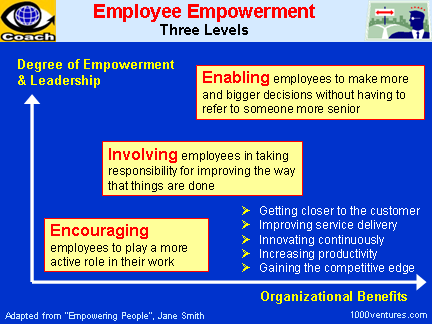
Getting empowerment into perspective: a three-stage training framework
Author(s): John Nicholls Journal: Empowerment in Organizations ISSN: 0968-4891 Year: 1995 Volume: 3 Issue: 2 Page: 6 - 11 Publisher: MCB UP Ltd
Wednesday, 27 June 2007
Responsibility, attitude and accountability
copyright Pearce Innovations, LLC. Paper given by Marc Pearce Vice President.... continued from previous post.
Quality and safety also an issue
Building projects, by their dynamic nature, involve other responsibilities — namely quality and safety — that deserve similar attention. As managers, we should define specific goals for these areas too. Of course, each supervisor may have different requirements, depending on his(her) trade, but it's still important to establish guidelines. Quality success, for instance, may be defined as:
- Installation meets specification.
- Rework is less than one percent
- Zero compliance items remain at the completion of an activity.
As for safety, it is, and should be, one of the highest priorities for builders today. Injuries can devastate a project in both money and morale, not to mention taint the reputation of the company. Supervisors and their subordinates make the best safety proponents on any construction project. You can empower them by defining aggressive requirements involving everyone. Safety success might include:
- Four safety audits performed each week by every front line supervisor
- Periodic examination by project and upper managers of safety practices being implemented
- Random interviews with subordinates by managers to determine the perceived attitudes toward safety of their supervisors
Attitude Is Key
Schedule, cost, quality and safety are fairly easy to define and, if managed professionally, will net a satisfactory project. But there's another "softer," more elusive issue that can have a profound impact on the project too. Attitude, in my opinion, is everything. It involves managers, supervisors and subordinates. It permeates all aspects of the project and site: In planning the work, in delivering a quality product, in training for safety, and in interacting with both internal and external clients. As managers, we usually know the type of attitude we want to see in others. The trick is to convey that message to our supervisors. Attitude success might include:
- Cooperation – readily helps subordinates and other front line Supervisors
- Communication – readily and accurately shares information with subordinates, peers and managers
- Teamwork – readily implements team and morale building activities or functions.
But how do we actually measure attitude since it involves perception? It's really quite easy once you've defined what's acceptable and what's not acceptable. You simply score each person, based on the collective observations of managers, peers and subordinates. I have to admit, measuring attitude can yield a few surprises. On one or two occasions, my perception of a particular supervisor has been considerably different than that of their subordinates.
But the underlying message is that by talking to others you gain valuable insight. For instance, some of the most experienced supervisors can be some of the worst communicators. Yet by learning that, you can provide specific training so that a supervisor not only improves his(her) skills but takes one step closer to success.
Accountability Is Essential
As a manager, you'll probably have other objectives or targets important to your organisation that you'll want to measure. After defining all the elements of a supervisor's success, you need to periodically monitor his(her) performance. Gathering, reporting and analyzing data is critical in measuring an individual's progress. But you'll need to determine how, and with what frequency, that information is collected and shared.
There is any number of measuring sticks to score a person's performance. It can be as simple as checking a "yes" or "no," indicating achievement of a specific target or marking a scale from one to five – or zero to 100 percent.
Whatever the gauge, by formally grading supervisory performance, managers can pinpoint accurately what and where attention is needed. For example, a supervisor who routinely scores low on safety may be putting others at high risk for an incident. Or a supervisor who seems to have a substantial rework rate could be experiencing outside influences – such as design or material deficiencies – that negatively affect performance. Low scores will trigger management to act. Periodically reviewing and adjusting each supervisor's goals, as predicated by the project, has to be part of the process. Objectives may be different, for instance, during the design-versus construction phases. A word to the wise: Invite front line supervisors to be part of the goal-setting and evaluation process.
You'll have instant feedback on how the program is playing – and a perfect backdrop for getting supervisors to buy-in. What's important is to focus attention where it's needed with laser-type accuracy instead of a shotgun approach.
Recognise and Reward
Managers are sometimes quick to discipline, but slow to recognise. But the suggestions enumerated here should help you identify those supervisors who are excelling within your organisation and, more important, merit your praise.
Supervisors who are successful in meeting their goals deserve to be rewarded, even if it's just a kind word. Too often, however, I think we ignore the obvious: Recognition, given in front of peers, goes a long way in lifting a team's spirit and improving morale.
Upper management should also encourage successful supervisors to acknowledge subordinates who've contributed positively to the team effort. Rewards don't need to be elaborate or expensive. Gift certificates or a catered lunch will suffice. The idea is just to motivate others by acknowledging "job well done."
You might be surprised at the spin-offs. Recognition will foster an innovative environment where camaraderie and even friendly competition helps everyone meet overall objectives.
The bottomline? Organisations that help supervisors be successful – and recognise them in the process – can expect measurable increases in performance and efficiency.
Pearce Innovations • www.pearceinnovations.com •